
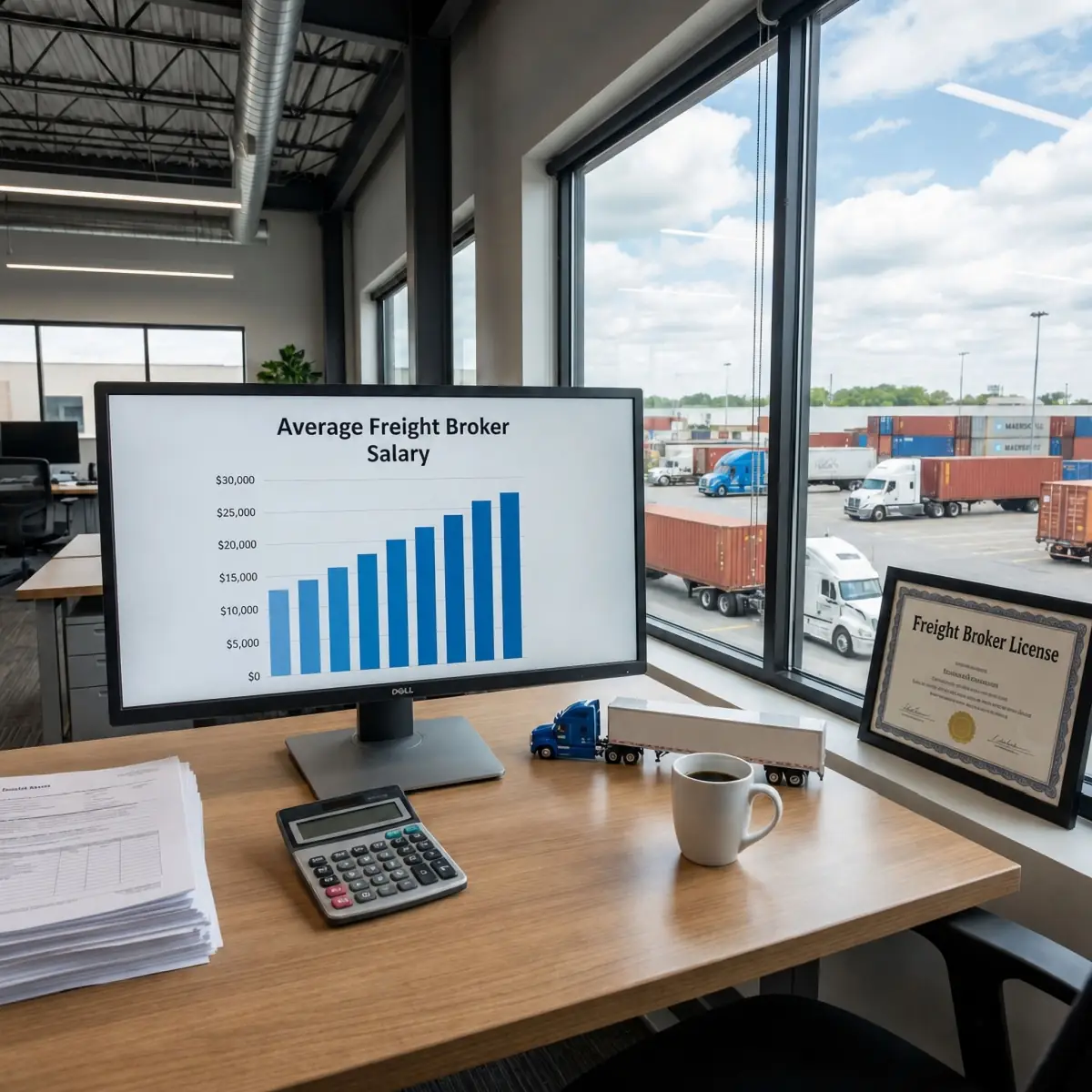
The freight brokerage industry is attracting a large pool of professionals interested in performance driven careers offering attractive incomes, however this is more complicated than any one number. As of 2025 statistics, freight broker average salaries range from $66,677 to $70,000 per year. Actual earnings fluctuate significantly depending on employment type, experience, and location.
Entry level brokers earn $45,000-$50,000 while experienced make $150,000+. When business owners scale their businesses, they can make over $300,000 a year. This guide explains exactly why these differences occur.
Quick Salary Overview
Average Freight Broker Salary: $66,677 – $70,000/year
Entry-Level Range: $45,000 – $50,000/year
Experienced Brokers: $85,000 – $150,000+/year
Business Owners: $100,000 – $300,000+/year
Per Load Earnings: $100 – $500 per load
Freight Broker Salary by Experience Level
| Experience: | Average Annual Income: |
|---|---|
| Entry-Level (0-1 year) | $45,000 – $55,000 |
| Early Career (1-4 years) | $50,000 – $75,000 |
| Mid-Career (5-9 years) | $65,000 – $100,000 |
| Experienced (10+ years) | $85,000 – $150,000+ |
| Business Owners | $100,000 – $300,000+ |
The Three Ways Freight Brokers Get Paid
W-2 Employee Brokers: Salary + Commission
W-2 freight brokers work as employees and receive both base salary and commission, providing the most financial stability. Commission is calculated on gross margin. If a shipper pays $9,000 and the carrier gets $8,000, the gross margin is $1,000. The commission on that load is $150 at 15%. Most W-2 brokers generally make $70,000-$90,000 a year, while the top people make over $100,000.
Base Salary Range: $45,000 – $85,000/year
Commission Rate: 15-18% of gross profit margin
Total Annual Income: $60,000 – $110,000+
Benefits: Health insurance, 401(k), paid time off, training
Broker Agents (1099 Contractors): Earnings on commission
Broker agents operate under the supervision of another broker’s license. They receive no base salary but enjoy much higher commission splits. Agents choose their own schedules and clients and work with different brokers. If you don’t sell, you won’t earn anything that is the tradeoff. For a clearer insight, consider this real life example: An agent is on a 60% commission split. He is generating $100,000 monthly freight volume. Moreover, he is doing 20% margins en route. Therefore, we end up with $20,000 gross profit on monthly basis. Their share of 60% is worth $12000 a month or $144000 a year before taxes and expenses. Established agents normally make $70,000-$120,000. Top agents make $150,000-$200,000+.
Base Salary: $0.
The gross profit share is 50-70%
Yearly Earnings Between $50,000 – $250,000+.
Licensed Freight Brokers (Business Owners)
A licensed broker will own the company and keep all profits. For instance, if a brokerage does $1M in annual freight volume at 30% margins, that would be $300K of gross profit. After covering $120,000 in expenses, the owner nets a profit of $180,000. The main issue involves cash flow. Carriers are paid by brokers after 30 days. Shippers take 60-90 days.
They will require a surety bond of $75,000, insurance, software and working capital.
Annual Income: $100,000 – $300,000+.
How Much Do Freight Brokers Make Per Load?
Understanding per-load earnings clarifies daily income potential.
Typical Gross Margin Per Load: 10-35% of load value
Average Dollar Margin: $150-$400 per load
Specialized Freight: $300-$500+ per load
Per-Load Breakdown Example
Load Details: Shipper pays $2,500, carrier receives $2,000
Gross Margin: $500
- W-2 Broker (15% commission): $75
- Agent (60% split): $300
- Licensed Broker (100%): $500
Volume Impact on Annual Income:
| Weekly Loads: | Avg Margin: | Employment Type: | Annual Gross: | Broker Take-Home: |
|---|---|---|---|---|
| 10 loads | $200 | W-2 (15%) | $104,000 | $15,600 |
| 25 loads | $200 | W-2 (15%) | $260,000 | $39,000 |
| 40 loads | $200 | W-2 (15%) | $416,000 | $62,400 |
| 25 loads | $200 | Agent (60%) | $260,000 | $156,000 |
| 40 loads | $200 | Agent (60%) | $416,000 | $249,600 |
Volume matters tremendously. An agent handling 25 loads weekly at $200 margin earns $156,000 annually—nearly triple what a W-2 broker earns on the same volume.
High-Margin Freight Types
- Refrigerated (Reefer): 20-30% margins
- Hazardous Materials: 25-35% margins
- Oversized/Heavy Haul: 25-40% margins
- Expedited Freight: 30-45% margins
- Cross-Border: 25-35% margins
Specializing in these niches can improve earnings compared to standard dry van freight.
Freight Broker Salary by State (2025)
Location dramatically impacts earnings, with differences exceeding 50% between highest and lowest-paying states.
Top 10 Highest-Paying States
| State: | Average Annual Salary: |
|---|---|
| California | $102,500 |
| Washington, DC | $72,000+ |
| New York | $70,000+ |
| Massachusetts | $67,000+ |
| Illinois | $66,448 |
| Connecticut | $65,000+ |
| Georgia | $63,896 |
| Florida | $62,515 |
| Texas | $61,921 |
| Ohio | $62,268 |
Lowest-Paying States
| State: | Average Annual Salary: |
|---|---|
| West Virginia | $37,750 |
| Vermont | $38,040 |
| Alaska | $39,620 |
| Wisconsin | $39,710 |
| North Dakota | $41,100 |
Remote Work Advantage: Many brokers now work remotely, allowing them to live in low-cost states while earning commissions on high-volume national freight lanes.
Key Factors That Increase Freight Broker Income.
- Negotiation Skills Matter Most
Those brokers who can negotiate rates make 80% more than those who accept market rates. When you negotiate well with your shipper and carrier, you lock in your rates while minimizing what you pay your carrier. This directly leads to increased gross margins. - Technology Multiplies Efficiency
Automation tools help brokers to increase revenue by 30% by handling more loads. Essential tools include.
- Load boards (DAT, Truckstop): Find capacity quickly
- TMS platforms: Automate documentation and tracking
- Rate analysis tools: Identify profitable lanes
- CRM systems: Manage relationships and follow-ups
- Specialization Commands Premium Rates
Brokers dealing in intricate freight types (hazmat, reefer, oversized) earn 40% to 60% more than generalists due to reduced competition and niche knowledge. - Experience Accelerates Growth
Many new brokers struggle to develop the skills and connections needed to succeed during their first year. In most cases, brokers enhance their carrier networks and establish shipper relationships that lead to repeat business, Causing their income to potentially double from year one to year three. - Carrier Relationships Enable Volume
A strong network of carriers allows brokers to serve loads at a quicker rate, plus handle more volume and get better prices. Premier freight brokers have ties to 50 to 100 vetted carriers.
Proven Strategies to Increase Your Salary
Maximize Load Volume
Handle 30-40 loads weekly instead of 10-15. Utilize load boards wisely, automate your admin tasks, and create systems to handle more loads at the same time.
Optimize Margins on Both Sides
- Convince your shipper to pay you more by being reliable.
- By building relationships and committing volumes, you are able to secure competitive carrier rates.
- Emphasize on transportation routes and materials with higher profitability.
Specialize in Niche Markets.
Develop expertise in high margin freight.
- Pharmaceutical shipments (temperature-controlled, high security).
- Cross-border freight (customs knowledge required).
- Hazardous materials (regulatory expertise).
- Time-critical expedited freight.
Transition Strategically
Many successful brokers follow this path.
- Years 1-2: Work as a W-2 employee to learn fundamentals and earn a steady paycheck.
- A real estate broker agent offers higher commissions and leverage experience.
- Broker with license (increase long term wealth) age 6+ years
Leverage Remote Work.
Live in inexpensive states while servicing high-volume locations. A broker making $80,000 in TN has more purchasing power than a broker making $100,000 in CA.
Commission Structure Explained
Freight brokers earn commission based on gross margin, not revenue.
Calculation:
Gross Margin = Shipper Payment – Carrier Payment
Example:
- Shipper pays: $10,000
- Carrier receives: $8,500
- Gross margin: $1,500
Broker Earnings would be:
- W-2 broker (15%): $225
- Agent (60%): $900
- Owner (100%): $1,500
Many brokerages use tiered commission structures that reward high performers:
Example Tier Structure:
- $0-$50K monthly margin: 10% commission
- $50K-$100K monthly: 15% commission
- $100K+ monthly: 20% commission

Industry Outlook: Strong Growth Through 2034
The freight brokerage market is projected to grow from $54.87 billion in 2024 to $98.73 billion by 2034—a 6% annual growth rate. Key growth drivers include:
- E-commerce expansion: Online retail freight increased 21% year-over-year
- Driver shortage: 78,000+ driver deficit creates demand for broker services
- Digital transformation: Technology platforms growing at 27.3% annually
- Supply chain complexity: Companies increasingly outsource logistics
This sustained growth creates expanding opportunities for freight brokers at all levels.
Is Freight Brokerage Right for You?
Ideal Candidates
✅ Enjoy sales, negotiation, and relationship building
✅ Comfortable with phone-based work and rejection
✅ Self-motivated and performance-driven
✅ Strong organizational and multitasking skills
✅ Willing to work 50+ hours during growth phase
✅ Technology-comfortable with software platforms
Not Recommended If You
❌ Need guaranteed steady income without performance variation
❌ Prefer behind-the-scenes work over sales
❌ Struggle with high-pressure situations
❌ Want strict 9-5 hours
❌ Dislike phone communication
Career Advantages
- Income potential: $70,000-$150,000+ for experienced brokers
- Remote work: Many positions fully remote with flexible schedules
- Clear progression: W-2 → Agent → Owner path
- Growing industry: 6% annual growth through 2034
- Low barriers: No degree required
Career Challenges
- Income uncertainty: Especially for commission
- Steep learning curve: First year is financially difficult
- Stressful work: Tight deadlines, demanding customers
- Long hours: 50-60+ hours weekly for top earners
- Economic sensitivity: Freight volumes drop during recessions
Conclusion: Earnings Reflect Effort and Strategy
How much do freight brokers make? It depends entirely on your path and execution:
- W-2 Employees: $60,000-$100,000 (stable, benefits included)
- Broker Agents: $70,000-$200,000+ (high upside, higher risk)
- Business Owners: $100,000-$300,000+ (unlimited potential, highest risk)
Entry-level brokers make approximately $45,000–$50,000 while they learn the business. Mid-career professionals earn $70,000-$100,000 with established books. Trained brokers and business owners who master can earn $150,000-$300,000 annually.
The main differentiators are 30-50 loads handled weekly, high margin freight specialization, technology adoption to automate and handle a larger load and strong relationships creating repeat and referral business.
The freight brokerage industry is projected to continue growing, meaning there will be brokers who connect shippers and carriers in demand. For those that are willing to stick with it through the learning curve and get the essential skills, freight brokerage can be a great source of income and career flexibility in an essential industry.
